Mega-Throughput Screening of Large OBOC Non-Natural Peptide Libraries and the Discovery of Synthetic Intrinsically Disordered Protein Mimics
333 Ravenswood Avenue, Menlo Park CA 94025
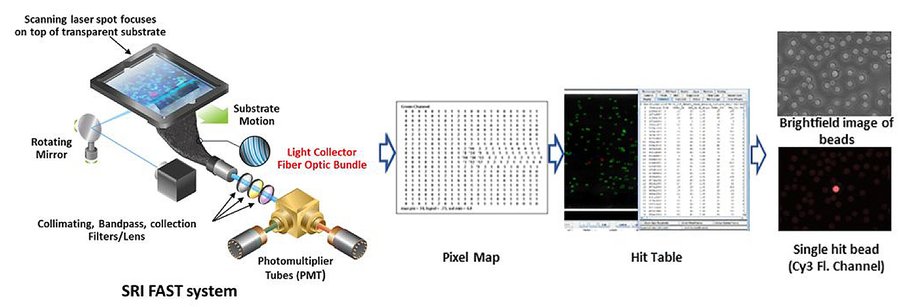
The one-bead-one-compound (OBOC) method pioneered at Selectide Corporation established a foundation for modern combinatorial chemistry by enabling large solid-phase peptide libraries. Here we describe a next-generation OBOC platform that enables exploration of increasingly non-canonical peptides by integrating a self-readable design with ultra-high-throughput Fiber-optic Array Scanning Technology (FAST) screening. Libraries of 10⁷–10⁹ sequences can be searched producing new insights into molecular structure and interactions such as the discovery of a new class of synthetic polymers that mimic intrinsically disordered proteins. This new approach has produced potent binders to challenging targets including KRAS, IL-6, TNFα, ASGPR1, and SARS-CoV-2 spike protein.
References
- Avital-Shmilovici M, Liu X, Shaler T, et al. Mega-High-Throughput Screening Platform for the Discovery of Biologically Relevant Sequence-Defined Non-Natural Polymers. ACS Central Science 8, 86–101 (2022).